

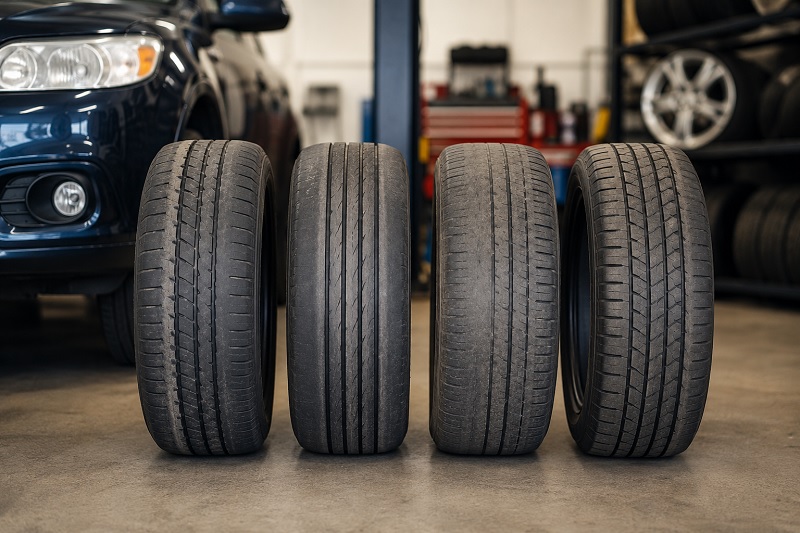
The four contact patches where your vehicle meets the pavement are the ultimate physical record of your car’s mechanical health. While most drivers only inspect their tires to check for basic tread depth or an obvious puncture, those thick bands of rubber are constantly recording detailed diagnostic information about the underlying suspension and steering systems. Every bump, every misalignment, and every worn component leaves a distinct physical signature on the tread over time.
Understanding how to read these specific wear patterns transforms a routine visual inspection into an advanced diagnostic assessment. Instead of waiting for a catastrophic suspension failure or a dangerous blowout, you can identify underlying mechanical issues months before they become expensive repairs. By learning to decode the visual and tactile signs of cupping, feathering, and camber wear, you gain a massive advantage in maintaining your vehicle’s safety, handling dynamics, and overall operational efficiency.
The Mechanics of Uneven Tread Degradation
To understand why tires wear unevenly, it is crucial to recognize that a rolling tire is subjected to immense physical forces. Under optimal conditions, the weight of the vehicle is distributed evenly across the entire width of the tread, and the tire rolls perfectly parallel to the direction of travel.
However, a vehicle’s suspension and steering geometry is an intricate network of control arms, tie rods, bushings, springs, and shock absorbers. When just one of these components falls out of specification due to age, impact damage, or general metal fatigue, the geometry shifts. This shift forces the tire to drag, bounce, or lean as it moves down the road. Because automotive rubber is relatively soft compared to the abrasive asphalt, the friction generated by these incorrect angles accelerates wear in highly specific, recognizable patterns.
Cupping Wear: The Suspension Warning Sign
Cupping, frequently referred to in the automotive industry as scalloping or chop, is one of the most alarming wear patterns to discover. It rarely points to a problem with the tire itself, but rather indicates a severe failure in the vehicle’s ability to control its own unsprung weight.
Identifying the Scalloped Pattern
If your tire is cupping, you will notice distinct, localized dips, craters, or hollows scooped out of the tread surface. These worn spots typically appear around the outer edges of the tire but can occasionally span the entire width. Rather than a smooth, continuous wear line, the tread will look like a miniature mountain range of high and low spots. Drivers usually feel cupping before they see it; the uneven surface creates a rhythmic rumbling or vibrating sensation that translates directly through the steering wheel or floorboards, particularly at highway speeds.
The Root Mechanical Causes
The primary culprit behind cupping is almost always a worn or compromised dampening system, specifically the shock absorbers or MacPherson struts. The job of a shock absorber is not to support the weight of the car, but to stop the suspension springs from bouncing endlessly after hitting a bump.
When a shock absorber fails and loses its internal hydraulic pressure, the wheel is left to bounce completely uncontrolled as it rolls over microscopic road imperfections. With every aggressive bounce, the tire momentarily loses contact with the pavement, only to slam back down a fraction of a second later. This violent, repetitive slamming action literally grinds small craters into the rubber. Secondary causes can include severely unbalanced wheels or bent rims that create a harmonic vibration, though these usually result in more uniform bald patches rather than widespread scalloping.
Corrective and Preventative Actions
Tires that have developed deep cupping patterns are permanently damaged and must be replaced, as the uneven surface will continue to degrade ride quality and compromise wet-weather traction. However, replacing the rubber without addressing the mechanical fault guarantees the new tires will suffer the exact same fate. A comprehensive inspection of the vehicle’s struts, shocks, and suspension bushings is mandatory, followed by a computerized wheel balancing session.
Feathering: The Alignment Indicator
Feathering is a subtle, directional wear pattern that can be difficult to spot with the naked eye but is immediately apparent once you know how to feel for it. It is the classic symptom of a vehicle suffering from a specific type of steering misalignment.
How to Detect Feathered Tread
To check for feathering, you must run your bare hand flat across the tread blocks from the outside edge of the tire toward the inside edge, and then back again. If the tread blocks feel completely smooth when sweeping your hand in one direction, but sharp, rough, or jagged when sweeping in the opposite direction, the tire is feathered. The individual blocks of rubber have been worn down into a ramp-like shape, leaving a sharp trailing edge.
The Impact of Incorrect Toe Angles
Feathering is the direct physical result of an incorrect toe angle. In automotive alignment, “toe” refers to whether the fronts of the tires are pointing slightly inward toward each other (toe-in) or slightly outward away from each other (toe-out) when the steering wheel is perfectly straight.
If the toe setting is knocked out of its factory specification—often caused by hitting a deep pothole or clipping a curb—the tires are no longer rolling parallel to the road. Instead, they are being forcefully scrubbed sideways across the abrasive pavement for every mile you drive. This constant diagonal dragging motion shaves the rubber off in a directional pattern. A severe toe misalignment will completely destroy a brand-new set of premium tires in a matter of a few thousand miles.
Restoring Proper Geometry
Correcting a feathering issue requires a professional four-wheel alignment on a laser-guided rack. The technician will adjust the tie rod ends to bring the steering geometry back to the manufacturer’s exact specifications. If the feathering is caught early enough, rotating the tires to a different position on the vehicle can sometimes allow the tread to even out over time, though advanced feathering will require immediate tire replacement to restore safe handling.
Camber Wear: The Weight Distribution Problem
Camber wear is visually dramatic and dangerous because it concentrates the entire weight and braking force of the vehicle onto a fraction of the tire’s intended contact patch.
Visualizing the Wear Pattern
A tire exhibiting camber wear will look heavily degraded on either the extreme inner shoulder or the extreme outer shoulder, while the opposite side of the tread looks relatively pristine. In severe cases, the affected shoulder will be worn completely bald, exposing the underlying steel belts and fabric cords, rendering the tire an immediate blowout hazard.
Positive and Negative Camber Issues
This pattern is caused by a misalignment of the camber angle, which is the inward or outward tilt of the wheel when viewed from the front of the vehicle.
-
Negative Camber: The top of the tire leans inward toward the engine block. This concentrates all road friction on the inner edge of the tire.
-
Positive Camber: The top of the tire leans outward away from the vehicle. This forces the outer edge to bear the brunt of the road friction.
While sports cars utilize a slight degree of negative camber to improve cornering grip, excessive camber wear on a daily commuter vehicle indicates that the suspension geometry has collapsed. This is frequently caused by sagging coil springs, worn-out ball joints, or bent control arms that can no longer hold the wheel perfectly vertical against the weight of the chassis.
Structural Corrections
Because camber wear often points to structural fatigue rather than just a simple adjustment issue, the mechanic must physically inspect the ball joints and control arm bushings for excessive play. Once the worn metal components are replaced, a full camber alignment will stand the wheel back upright, allowing the tire to distribute the vehicle’s weight across the entire width of the tread footprint.
Proactive Maintenance and Inspection Routines
Waiting for a steering vibration or a visible bald spot to check your tires is a reactive strategy that ultimately costs you money. The most effective way to combat uneven wear is to integrate tire inspections into your regular automotive routine.
Running your hands over the front tires once a month takes less than a minute but can save thousands of dollars in premature replacement costs. Furthermore, adhering to a strict tire rotation schedule—typically every 5,000 to 7,000 miles—ensures that the unique mechanical forces exerted by the front and rear axles are distributed evenly across all four tires over their lifespan. Combining this physical rotation with an annual alignment check provides a comprehensive defense against geometry-induced tread degradation.
By treating your tires as a diagnostic interface rather than just consumable maintenance items, you gain deep visibility into the mechanical integrity of your vehicle. Cupping, feathering, and camber wear are not random occurrences; they are specific mechanical warnings. Learning to read these warnings ensures that your suspension remains structurally sound, your steering remains razor-sharp, and your vehicle operates exactly as the engineers intended.
