

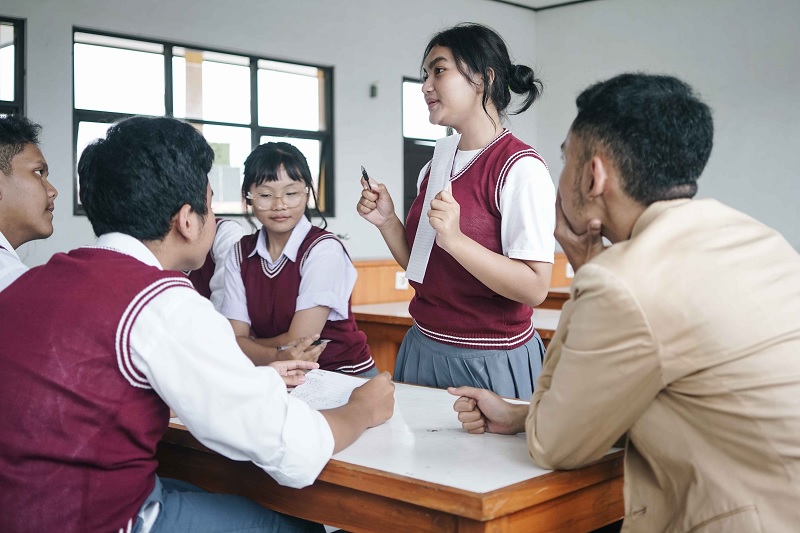
Most people view education as a system designed strictly to transfer knowledge. You attend classes, memorize facts, take exams, and eventually graduate with a certificate proving you have absorbed a certain amount of information. However, this transactional perspective entirely misses the underlying architecture of a good education. The true value of time spent in schools and universities lies not just in the data you consume, but in the highly adaptable soft skills you develop along the way. Chief among these is the ability to communicate effectively.
Educational environments serve as a vital incubator for interpersonal development, offering a structured, low-risk space where students can learn to articulate complex ideas, understand diverse perspectives, and interact meaningfully with the world around them. While textbooks provide the raw material, it is the interactive nature of education that teaches students how to process, share, and utilize that material in the real world.
Beyond the Curriculum: Why Communication Matters
There is a profound difference between understanding a concept and being able to explain it to someone else. You might grasp the intricacies of a complex mathematical theorem or the historical causes of a major conflict, but if you cannot convey that understanding clearly, the knowledge remains locked inside your own mind. Education bridges this gap. It forces students out of passive consumption and into active expression.
When teachers ask students to participate in discussions, write essays, or present findings, they are demanding that students organize their thoughts and share them intelligibly. This shift is where raw information transforms into applicable intelligence. The classroom serves as a proving ground where ideas are tested not just for their factual accuracy, but for their communicative clarity.
The Shift from Passive Listening to Active Engagement
Historically, classrooms were heavily tilted toward lecture-based learning, where the teacher spoke and the students simply transcribed. Today, the educational landscape prioritizes dynamic interaction. The modern classroom requires students to speak up, debate, and collaborate. This pedagogical shift means that students are constantly practicing the art of forming arguments on the spot, defending their viewpoints, and responding intelligently to counter-arguments.
They learn to read the room, adjust their tone, and gauge whether their audience is following along. These micro-interactions happen daily, subtly building a foundation of communicative competence that students will rely on long after they have forgotten the specific details of the day’s lesson.
Core Communication Skills Fostered in Educational Settings
Communication is not a single, monolithic skill. It is a complex web of different abilities that must be honed individually and then synthesized. The classroom is uniquely equipped to develop these distinct areas through targeted academic exercises that challenge students in varied ways.
Verbal Articulation and Public Speaking
For many adults, public speaking remains a source of intense anxiety. Schools and universities provide a controlled environment to confront and manage this fear early in life. Through mandatory presentations, oral exams, and class debates, students learn to project their voices, maintain eye contact, and manage their physical presence under pressure.
More importantly, they learn the mechanics of structuring a verbal presentation. They discover how to hook an audience, signpost their main points so listeners can follow along, and deliver a compelling conclusion. Over time, the terrifying prospect of standing in front of a room becomes a manageable, even routine task. Building this sense of verbal confidence is absolutely crucial for future leadership, allowing individuals to speak with authority rather than hesitation.
Written Proficiency in a Digital Age
While verbal communication often gets the spotlight, written communication is just as vital, particularly in our increasingly digital and remote-working world. Academic writing forces students to be meticulous with their phrasing. When writing a research paper or a persuasive essay, students cannot rely on body language, hand gestures, or vocal inflection to carry their meaning. They must choose precisely the right words, structure their sentences logically, and build paragraphs that flow seamlessly into one another.
This rigorous attention to written detail translates directly into the professional realm. The discipline required to write a cohesive term paper is the exact same discipline required to craft clear emails, draft coherent project reports, and communicate professionally with clients. Education teaches the critical difference between firing off a casual text message to a friend and drafting a formal, persuasive proposal that drives business decisions.
Active Listening and Empathy
It is easy to forget that communication is a two-way street. The ability to listen is just as important as the ability to speak, yet it is rarely practiced intentionally outside of academic and therapeutic settings. Educational environments inherently demand active listening. To succeed, students must listen closely to their instructors to grasp complex materials, but they must also listen to their peers during open discussions.
Active listening goes beyond simply hearing words. It involves interpreting meaning, noticing verbal nuances, and understanding the context behind a statement. When students listen to a classmate present a differing political or philosophical viewpoint, they are practicing empathy. They are learning to step outside their own worldview and consider a problem from another angle, which is the foundational bedrock of effective conflict resolution.
The Role of Collaborative Learning
No student succeeds entirely in a vacuum, and modern education reflects this reality. Group projects are a staple of the educational journey, and they serve as a rigorous crash course in interpersonal dynamics. When a group of students is tasked with delivering a joint project, they must immediately establish reliable lines of communication. They have to delegate tasks based on individual strengths, establish timelines, and hold each other accountable without the benefit of formal authority.
Inevitably, these collaborations involve friction. Disagreements arise over the creative direction of the project, the fairness of the division of labor, or the quality of the final output. Navigating these inevitable conflicts is where highly practical communication skills are forged. Students learn the delicate art of compromise. They learn how to give directions without being dictatorial and how to push back against a flawed idea without insulting the person who suggested it. These peer-to-peer interactions closely mimic the exact dynamics found in corporate boardrooms, non-profit committees, and professional project teams.
Navigating Constructive Feedback
One of the most difficult aspects of human communication is giving and receiving criticism. Human nature often compels us to become defensive when our work is critiqued. Education serves to normalize the feedback loop. When a student hands in an essay and receives it back covered in corrections, they are engaging in a highly beneficial communicative process. A skilled educator does not just point out flaws; they explain the reasoning behind the critique and offer actionable steps for improvement.
Through this ongoing, multi-year cycle of drafting, receiving feedback, and revising, students learn to separate their self-worth from their work. They learn to view criticism as a necessary tool for growth rather than a personal attack. Conversely, through peer review exercises, students also learn how to deliver constructive feedback to others. They learn to phrase their critiques diplomatically, pointing out areas for improvement while also validating their peer’s hard work. This dual ability to accept critique gracefully and offer it constructively is a rare trait that drastically improves both personal and professional relationships.
Real-World Application: The Professional Edge
When corporate recruiters and hiring managers are asked what they look for in new candidates, technical proficiency is rarely at the absolute top of the list. Hard skills and specific software knowledge can usually be taught on the job. What employers desperately seek are candidates with strong soft skills, with clear communication reigning supreme across all industries.
A brilliant software engineer who cannot explain their code architecture to a non-technical product manager becomes a workflow bottleneck. A highly skilled financial analyst who cannot translate a spreadsheet into a compelling narrative for stakeholders limits their own upward mobility. The communication skills developed through formal education provide a massive competitive edge in the job market. From the initial cover letter and job interview to daily interactions with colleagues, the ability to articulate thoughts clearly dictates the trajectory of a career. Professionals who can synthesize complex information, mediate workplace disputes, and present compelling narratives are the ones inevitably promoted into leadership positions.
Fostering a Lifelong Communication Habit
The final, and perhaps most profound, impact of developing communication skills through education is that it sets the stage for lifelong intellectual engagement. The world is changing at a rapid pace, and the specific facts and figures a student learns in middle school or college may become obsolete within a decade. However, the ability to ask the right questions, synthesize newly acquired information, and discuss emerging ideas with others will never lose its value.
Education provides the initial scaffolding, but the mastery of communication is a lifelong pursuit. The essays, debates, and collaborative projects of academic life are simply the beginning. They instill a habit of thoughtful articulation and curious listening. When educational institutions prioritize the development of these skills, they are doing much more than helping students pass standardized exams or land their first entry-level jobs. They are equipping the next generation with the fundamental tools required to build meaningful communities, drive industry innovation, and participate actively in the broader global conversation.
