

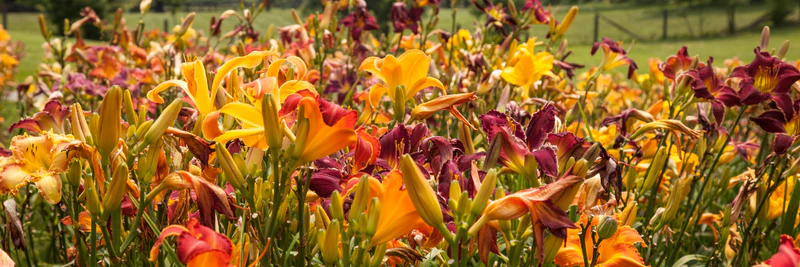
The strongest collections of daylilies are shaped around performance, season length, resilience, and the way individual plants behave over many years in ordinary garden conditions. Specialist growers understand this well. They do not simply assemble a large catalogue of colours and forms. They build a living range that helps gardeners create borders and mixed plantings with dependable value rather than short-lived excitement.
That distinction matters because daylilies are often bought in moments of impulse. A striking flower in a catalogue or display bed can persuade a buyer very quickly, yet a successful garden plant needs more than a memorable bloom. It must grow into a useful clump, flower reliably, tolerate weather swings, and sit well among neighbouring perennials, shrubs, and grasses. A collection with lasting garden value therefore depends on selection discipline. The best growers evaluate not only beauty, but also repeat performance, foliage quality, branching, bud count, flowering season, and tolerance of local conditions.
As professional advice from the premier grower of Daylily plants SwallowtailDaylilies puts it, buyers looking through daylilies plants for sale should think beyond single blooms and choose varieties that together provide continuity of colour, healthy clumps, and dependable flowering over time. That advice reflects the difference between buying isolated plants and building a collection that improves the whole garden.
For British gardeners, this approach is especially useful. Gardens here are often compact, borders must work hard for much of the year, and weather patterns can move from cool and wet to warm and dry with little warning. Daylilies suit these conditions when chosen with care. They can offer a long season, strong structure, and a wide range of colours without demanding intensive maintenance. What specialist growers add is a method: they help gardeners combine distinct cultivars into collections that earn their place year after year.
Why specialist growers choose collections rather than random variety
A specialist grower rarely thinks in terms of isolated stock. Plants are considered in relation to one another. This matters because a collection is more useful to a gardener than a series of disconnected choices. When plants are selected as a group, the result can cover early, mid, and late flowering periods, different heights, and a coordinated colour range that avoids visual confusion. Instead of a border peaking for ten days and then fading into an untidy lull, the garden gains rhythm and continuity.
This is one reason specialist nurseries tend to organise daylilies by habit and role as much as by colour. A taller cultivar may serve as a vertical note behind lower perennials. A compact one with strong foliage may work near the front of a mixed border. A repeat-flowering cultivar might be chosen not because it is the largest or most dramatic, but because it helps bridge the gap between early summer flushes and later displays. Such decisions reflect a design mentality as much as a horticultural one.
Random choice often creates avoidable problems. Similar colours can clash when their undertones differ. Large flowers may flop visually in small spaces. Very late cultivars may disappoint in cooler areas if they are slow to establish. Some plants look exceptional in a pot or display bench but do not hold their flowers well in exposed weather. Specialist growers learn these patterns through observation over several seasons, and they use that knowledge to shape ranges that are more useful to ordinary gardeners.
There is also an economic logic behind the collection approach. Gardeners who buy wisely once are less likely to spend again on replacements or disappointing experiments. A carefully built group of plants can mature into a stronger display with each year, offering better value than repeated impulse purchases. This longer view is part of the appeal of daylilies. Although individual flowers are short-lived, the clumps themselves can become more substantial and rewarding with time. Specialist growers understand that contradiction and turn it into an advantage by selecting varieties that improve with age rather than merely making a first impression.
The traits that give a daylily long-term garden value
Lasting garden value is shaped by a combination of visible and less obvious traits. Flower colour is important, but it is rarely the main factor in long-term success. Specialist growers often begin with vigour. A good cultivar should establish into a healthy clump without constant intervention. It should increase steadily, produce clean foliage, and respond well to division when necessary. Weak growers, however attractive their flowers, are less useful in real gardens where time and space are limited.
Flowering behaviour is another major consideration. Growers look closely at branching and bud count because these determine how generous the display will be. A daylily with well-spaced buds on strong scapes can provide a sustained show rather than a brief burst. Repeat flowering is prized, but only when it is reliable. There is little value in a label promising rebloom if the plant only performs that way under ideal conditions. Experienced growers prefer evidence gathered over several seasons, especially in variable weather.
Foliage quality is often overlooked by casual buyers, yet it has a strong effect on garden performance. Daylilies occupy space for much longer than the flowers remain open, so the leaves must contribute positively to the border. Tidy arching foliage can soften hard edges, link neighbouring plants, and provide movement even when blooms are absent. Coarse or collapsing leaves reduce the plant’s value after flowering. This is one reason specialist growers observe the whole plant through the season rather than judging only peak bloom.
Adaptability also matters. The best daylilies are not merely beautiful in a nursery row. They cope with ordinary soils, accept periodic dry spells once established, and withstand rain without complete collapse of the flowers. In Britain, where summer conditions can vary widely, this flexibility is particularly useful. Gardeners need plants that can continue performing despite weather that rarely matches catalogue perfection.
Finally, specialist growers value distinctness with purpose. A collection should include enough variation to be interesting, but not so much that it becomes incoherent. Some cultivars offer a clear garden role through height, flowering time, or unusual colour tones that combine well with common border companions. Others may be striking but hard to place. Long-term value usually comes from plants that are both distinctive and easy to use, a balance that separates serious garden performers from short-term curiosities.
How growers balance novelty with reliability
The world of daylilies is full of novelty. New introductions appear regularly with larger flowers, sharper edges, unusual markings, and more elaborate forms. Specialist growers appreciate innovation, but they tend to judge it against a practical standard: does this plant still earn its place after the excitement fades? That question keeps a collection grounded in garden reality.
Novelty has a role. It draws interest, broadens the palette, and allows gardeners to experiment with different moods and combinations. A dramatic near-black bloom, a heavily ruffled edge, or a rare shade can bring personality to a planting scheme. Yet novelty on its own can be a poor guide to value. Some unusual cultivars flower sparsely, dislike cooler summers, or make weak clumps. Others look impressive close up but disappear visually at a distance. A specialist grower filters novelty through repeated trial, keeping only those cultivars that offer both character and dependable performance.
This is where collection building becomes a disciplined exercise. Reliable core cultivars form the backbone. They may not always be the newest or most talked about, but they flower well, combine easily, and provide structure across the season. More unusual cultivars are then added in smaller numbers as accents. The result is a collection that feels fresh without becoming unstable. For the gardener, that means the border remains coherent even if one or two experimental plants underperform.
The same balance applies when customers search for daylilies plants for sale. A broad offer is not automatically a better one. What matters is whether the selection reflects testing, curation, and an understanding of how real gardens function. Specialist growers act as editors. They remove weak or unsuitable options and keep refining the range so that each addition has a reason to be there.
Reliability also strengthens design confidence. Gardeners are more willing to use distinctive flowers when they know the plant itself is structurally sound. A bold cultivar becomes less risky when its foliage is good, its flowering season is predictable, and its clump grows steadily. In that sense, specialist growers are not resisting novelty. They are making it useful. They turn eye-catching introductions into lasting garden assets by testing them against the demands of climate, maintenance, and design.
Building season, structure, and harmony in the garden
A lasting daylily collection is built not only around individual merit but around sequence. Specialist growers pay close attention to flowering season because one of the greatest strengths of daylilies is the ability to create progression across summer. Early cultivars start the season with fresh energy, mid-season cultivars carry the main display, and later ones prevent the border from feeling finished too soon. A gardener who selects from all three groups gets more than a longer display. They get a garden that evolves rather than peaks and declines abruptly.
Height and scale are managed with the same care. Mixed borders work best when taller cultivars are placed with intention and shorter ones support the front of the planting. Specialist growers usually know which daylilies remain neatly proportioned and which develop commanding flower scapes. That knowledge helps gardeners avoid a border that feels top-heavy or uneven. In smaller British gardens, where every plant must justify its footprint, this kind of guidance is particularly valuable.
Colour harmony is another quiet skill behind strong collections. Daylilies exist in warm apricots, creams, reds, purples, near-whites, and many blends between. Specialist growers understand that colours behave differently in the landscape than they do in close photography. Some tones glow at dusk, some flatten in harsh midday light, and some are excellent companions for roses, salvias, nepetas, or ornamental grasses. By grouping cultivars with an eye to compatibility rather than novelty alone, growers help gardeners achieve borders that feel composed rather than crowded.
Structure beyond flowering is equally important. Daylilies can act as linking plants, tying together shrubs and herbaceous perennials with their fountain-like foliage. They work especially well in plantings that need a dependable midsummer anchor. Because individual flowers are brief, the clump must hold the design together even on days when fewer blooms are open. Collections shaped by specialists tend to include plants with this broader structural value, rather than relying only on flower shape and pattern.
This is why the most successful collections often look restrained on paper. They are not trying to display every possible form. Instead, they offer a framework from which gardeners can build an elegant, durable scheme. A well-curated mix of flowering times, heights, and compatible colours creates a border that remains useful for years. The value lies not in owning many different labels, but in how well those plants work together in the changing life of the garden.
What British gardeners can learn from specialist selection methods
British gardeners do not need hundreds of cultivars to benefit from specialist methods. The main lesson is to select with purpose. Before buying, it helps to think about what the planting actually needs. Is the border short of midsummer colour? Does it need stronger front-edge planting? Is there a gap between early perennials and later asters or grasses? Daylilies can answer all of these questions, but only when the right cultivars are chosen.
A second lesson is to buy fewer, better plants. A small number of strong performers usually has more impact than a scattered assortment of novelties. Repeating a reliable cultivar can give a border cohesion and visual confidence. Specialist growers understand this instinctively. They know that garden value often increases through repetition, maturity, and steadiness rather than constant variety.
Gardeners should also observe beyond the flower. Foliage, clump shape, flowering duration, and recovery after adverse weather all matter. This is particularly true in Britain, where rain can test petal substance and where garden spaces are often expected to look presentable for long periods. A daylily that carries itself neatly before and after bloom will often prove more valuable than one with a sensational flower and poor overall habit.
Patience is another useful principle. Daylilies reward time. A newly planted division may look modest in its first season, but a well-chosen cultivar can become a substantial, dependable feature as it settles. Specialist growers build collections with that maturity in mind. They are thinking not only about what sells now, but about what will still be worth growing several years later. That perspective is worth adopting at home.
In the end, the lasting appeal of daylilies lies in this combination of generosity and discipline. They offer colour, adaptability, and breadth of choice, but they deliver the best results when chosen as part of a considered plan. Specialist growers build collections that reflect this truth. They test, compare, and refine until beauty and reliability meet. For gardeners, that means a better chance of creating borders that do not merely impress for a season, but continue to improve as the garden settles into itself.
